Rhona's* story
"There are many more families like ours in Scotland. Something has to change. We should have healthcare without boundaries and people should be able to drive their own care.
My family are from the Southwest of Scotland. My husband joined the army at 17 and was a career soldier for 24 years. He sustained multiple complex injuries while in service and by the time he returned from his final tour, he needed knee replacements in both legs and – though we didn’t know it at the time - he was also suffering from blast traumatic brain injuries and complex PTSD.
After leaving the military, his healthcare was handed over to the NHS. It was a battle to get his knees fixed because the injuries were complex and extensive so there was no one locally who could do the operation and the local health board refused to refer us elsewhere.
The pain was so significant, he was not able to walk. He couldn't sit down on the floor and change a nappy. He wasn't able to work. Eventually, we scraped together the money for a private consult in the central belt. The consultant recommended a treatment to our GP, but the local authority refused to pay for it. He had to wait to be treated locally. It took seven years.
While he waited, the pain and the effects of his brain injury caused his mental health to deteriorate. He would wake up with night traumas and he would be having seizures in the night. He wore a hole in the mattress from marching in his sleep.
As he started to fall apart, navigating services was impossible. Doctors didn’t know what to do. There were no trauma‑trained psychiatrists in our area, and he needed specialist brain scans, but they still refused to refer us elsewhere.
Not having a diagnosis was torture. He was trapped in the health care system here, and he became suicidal. He stood on the front line to protect everybody else's rights, and nobody would help him.
After he attempted to end his life, we had no other option but to sell our house to pay for private scans, which confirmed he had multiple blast traumatic brain injuries. That diagnosis gave him peace, and I believe that if he hadn’t got it when he did, he would be dead now. But even after he was diagnosed, the health board refused to refer him to the central belt for treatment.
There was no support in place at all. Our new home needed disability adaptations, but the local authority told us they didn’t have the money to do what we needed despite the NHS Occupational therapist stating the adaptations were essential and mandatory. I wasn’t offered community care. I got to the stage where, after some health issues of my own — COVID affected me and my son — the caring responsibilities doubled and I had to stop working too.
When my son developed serious complications from long COVID, it was like history repeating itself. We really struggled to access care for him. The doctor made me feel gaslit and really patronised, like I was just some over the top mother. It wasn't my first rodeo by that point, and I was aware of how difficult this was going to be.
We ended up using the remaining money from the house sale to go private again. He’s on medication now that helps but it’s been a slow process. He hasn’t been able to attend school, and we were denied home tutoring until a charity stepped in to advocate on his behalf.
I've gone through all of this with my husband, and they've not learned any lessons There are many more families like ours in Scotland. Something has to change. We should have healthcare without boundaries and people should be able to drive their own care. Those values of not walking past what’s wrong and helping those in difficulty— we need them applied at government level so all people in Scotland have equal access to the best services for them regardless of area of residence."
*Not her real name.
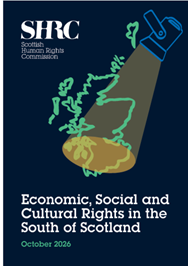
This is an excerpt from the SHRC's report on economic, social and cultural rights in the South of Scotland. ESC rights touch on every part of our daily lives and often have an impact on one another. The stories in this report demonstrate how human rights issues can affect people's lives.
Have 5 minutes?
Read one of the other three rights holder experiences in this report.
Have more time?
Read Economic, Social and Cultural Rights in the South of Scotland. Summary report, Easy Read and BSL versions can be accessed from the ESC rights in the South of Scotland webpage.