
Learning from communities
Our model of ESC rights monitoring brings us closer to the communities to directly bear witness to their human rights concerns. We use this model to build a picture of economic social and cultural rights realisation across Scotland.
In each area, we meet with human rights defenders, community groups and duty bearers to inform our research. Our reports chart the state of ESC rights in that area - allowing us and others to track progress or deterioration of rights - and make specific recommendations to duty bearers on how to make things better for people in the region.
What we have done so far
Highlands and Islands
We started the project in the place with the biggest gaps in human rights data: the Highlands and Islands. In 2023, we visited more than twenty towns across six local authorities and interviewed more than a hundred people .
Some of the most critical issues that we found were:
- Many people are unable to afford housing, to heat their homes or to travel to access healthcare.
- A significant number of people are homeless, and some are living in conditions of rooflessness, without shelter or temporary accommodation.
- A lack of locally available health services in certain areas including sexual and reproductive health services, meaning people have to travel great distances to access health services.
The impact
When we released our report on ESC rights in the Highlands and Islands, people took notice:
- In January 2025, the Scottish Parliament held a Members Debate put forward by Rhoda Grant, MSP for the Highlands and Islands to discuss the findings of our report.
- In February and March 2025, we travelled back to the Highlands and Islands to share the findings of this report and hold sessions on ESC rights framework designed to empower human rights defenders.
- In May 2025, the Scottish Government wrote to us with their response to the report. In their response, they welcomed the report, stated their commitment to protecting and promoting human rights and set out their plans for addressing our recommendations.
For more information on the project, visit the dedicated webpage on ESC rights in the Highlands and Islands.
South of Scotland
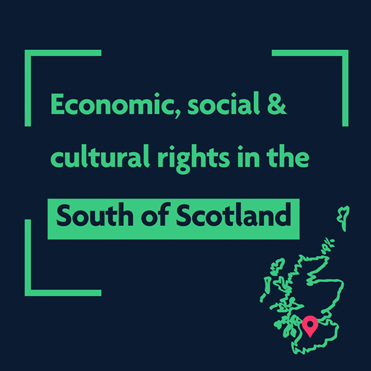
Our focus area for 2026 is the South of Scotland. In February and March 2026, we visited the South of Scotland, including Ayrshire, Cumbrae, and Arran to hear first-hand from human rights defenders on the ground about the issues facing their communities in Stranraer, Ayr, Dumfries, Kilmarnock, Hamilton, Irvine, Arran, Galashiels, Kelso, Dalkeith and Haddington.
Learn more about our work on ESC rights in the South of Scotland.
What is next and our other work
Our next spotlight will be Mid to Northeast Scotland. The project will conclude with a report on ESC rights in the Central Belt.
To find out more about ESC rights in Scotland, see our State of the Nation 2025 report.
Related publications

About our monitoring role
Under our founding legislation, the Scottish Commission for Human Rights Act 2006, the SHRC has a general duty to promote and encourage best practice for human rights.
An important part of this duty is monitoring how human rights are being experienced in Scotland. Independent monitoring can:
- highlight where things are going wrong early so that governments and parliaments can step in address or prevent violations of rights
- hold governments and parliaments accountable for their actions or failures to act by applying a consistent framework over time and regularly reminding them of their legal obligations
- promote transparency, collaboration and the rule of law, including through making independent conclusions and recommendations
As Scotland’s National Human Rights Institution, the SHRC is uniquely placed to take a big picture view of human rights, the gaps and progress. This project is a step towards establishing and maintaining that picture.
Our rights monitoring model is internationally recognised and has been lauded by the United Nations Office of the High Commissioner for Human Rights, the Global Alliance of National Human Rights Institutions, European Network of National Human Rights Institutions, the Council of Europe, civil society organisations, sister National Human Rights Institutions, rights holders and academic experts from across the globe.